
Sohonet’s Chuck Parker and Nordicity’s Dustin Chodorowicz explore the forces reshaping post-production and VFX, from AI and international competition to the latest data on the UK VFX industry
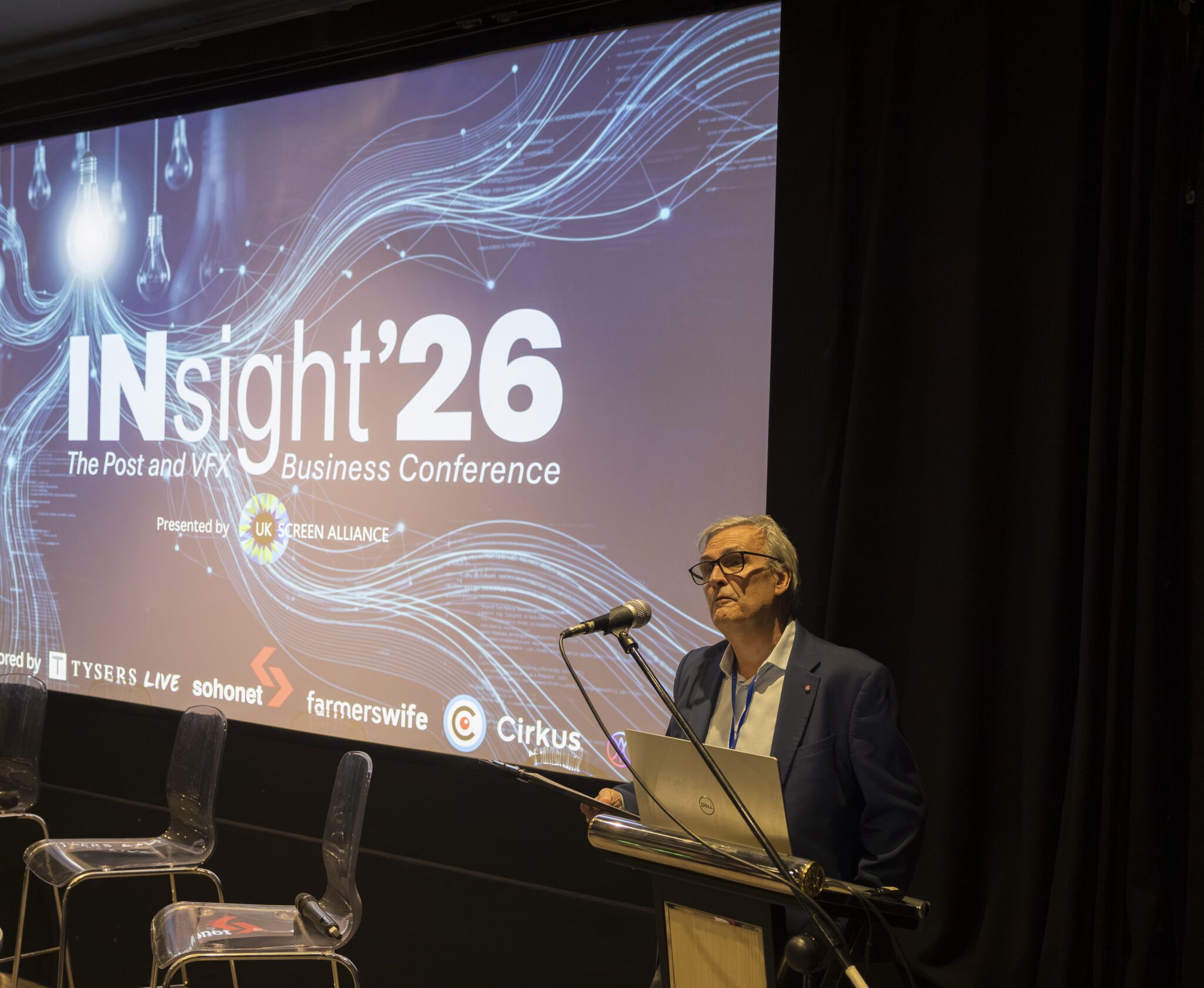


Chuck Parker, CEO of Sohonet, and Dustin Chodorowicz, Partner and Chief Economist at Nordicity, opened UK Screen Alliance’s inaugural INsight conference with an examination of the forces reshaping the screen industries, from shifting business models and international tax incentives to the gap between rising VFX revenues and falling employment.
UK Screen Alliance’s inaugural Post-Production and VFX Business Conference, INsight’26, opened with a clear objective: to equip businesses across post-production and visual effects (VFX) with the data and industry intelligence needed to make better-informed decisions.
Welcoming delegates, UK Screen Alliance CEO Neil Hatton introduced INsight’26 as a new annual conference focused on the business of post-production and VFX, bringing together industry professionals to examine the realities behind the headlines. The programme was designed to encourage open discussion of the sector’s most pressing challenges, with an emphasis on data-driven analysis and practical implications for businesses.
The opening keynote speakers were Chuck Parker, CEO of Sohonet, and Dustin Chodorowicz Partner and Chief Economist at Nordicity. Together, their presentations offered complementary perspectives: Parker explored the structural forces changing how content is financed, produced and monetised, while Chodorowicz presented data on the recent performance of the UK VFX industry and the early indications for 2025 and 2026.
Chuck Parker: Our industry in transition: Post, VFX, and the Policy Landscape
Parker outlined four interconnected forces affecting the future of post-production and VFX: changing film and television business models, evolving production workflows, advances in technology and AI, and international competition for production investment.
The shift from traditional television towards streaming and advertising-supported platforms is changing how content is financed and monetised. At the same time, remote workflows and advances in computing are transforming production processes, while AI is accelerating the development of tools and services. Parker referenced research suggesting that AI adoption was already helping some producers reduce production costs.
He also highlighted the growing importance of international tax incentives, including potential competition from US initiatives. For UK businesses, these developments underline the need to understand how policy and investment decisions elsewhere could affect the flow of work.
Parker argued that businesses should consider where their services deliver the greatest value. Routine, easily automated tasks may face increasing price pressure, while work requiring creative judgement and specialist expertise is harder to commoditise.
He also introduced the concept of Jevons’ paradox: when technology makes a process cheaper, demand may increase rather than simply reducing overall spending. In VFX, lower costs could encourage greater creative ambition and more complex work, rather than inevitably leading to smaller budgets.
Dustin Chodorowicz: UK VFX: Economic Trends, Outlook and Insights
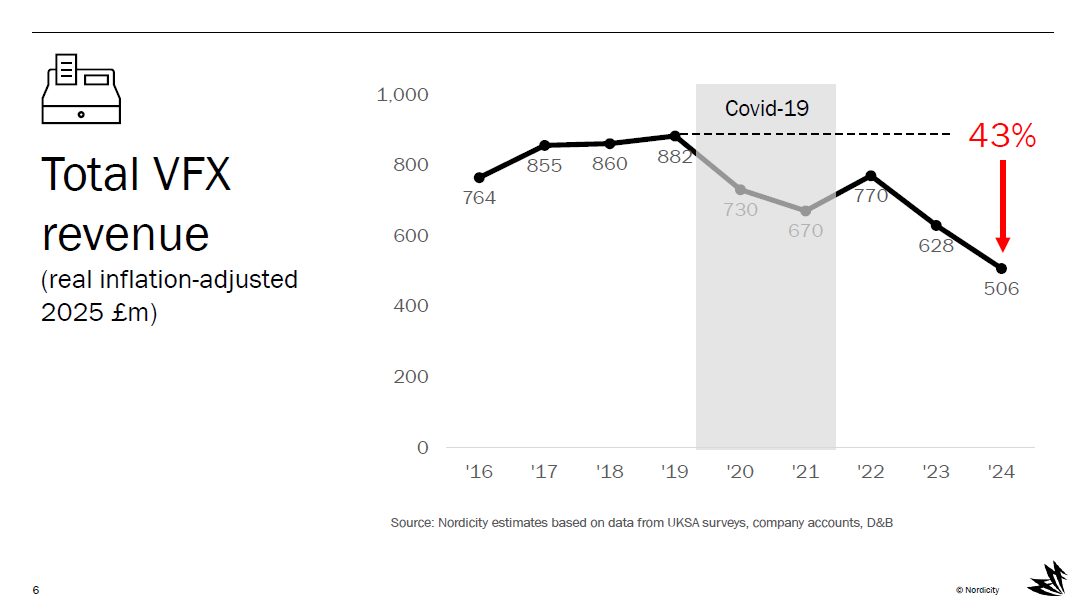
Chodorowicz presented research conducted by Nordicity, commissioned by UK Screen Alliance and the British Film Institute, drawing on company surveys, financial accounts and economic modelling. The findings highlighted an industry still facing significant pressure, despite some recent signs of revenue growth.
Adjusted for inflation, research shows that the UK VFX revenue in 2024 was estimated to be 43% smaller than before COVID. High-end television has become a more important source of work, while television commercials have declined as a share of the sector.
Early estimates for 2025 suggested that VFX revenue fell by around 2%, with headcount down by nearly 6%. The survey findings for the first half of 2026 offered a more mixed picture. Around 85% of surveyed companies reported higher VFX revenue than in the comparison period, with feature films the main source of growth, potentially as a result of the introduction of the VFX uplift to the AudioVisual Expenditure Credit on 1 April 2025. High-end television was broadly stable, while commercial work continued to decline. The share of turnover from overseas clients increased from 67% to 71%, although this growth appeared concentrated among larger companies.
Crucially though, the improvement in revenue was not translating into increased employment. Only around one in five companies reported growing their workforce, while approximately three-quarters reported reducing overall employment. Nearly 42% reported cutting full-time staff, highlighting the continued pressure on workers across the sector.
Revenue growth and the impact on jobs
Chodorowicz explored whether these trends could indicate a changing relationship between revenue and labour, including the potential impact of AI. A majority of surveyed companies reported a reduction in the monetary value of their payroll during 2026.
However, Chodorowicz stressed that these figures did not prove AI was responsible for job losses. Other commercial and operational pressures could also be contributing, and the available data could not isolate the effects of individual factors.
Instead, the findings raised important questions about how revenue is being distributed across the industry, and why improving turnover is not yet translating into a stronger recovery in employment.
An industry at a turning point
Together, the keynotes highlighted a sector undergoing significant technological and commercial change. Parker emphasised the need for businesses to adapt to evolving production models, AI and international competition, while Chodorowicz’s findings demonstrated that revenue growth does not necessarily mean a recovery for the wider workforce.
Both speakers underscored the importance of evidence-based decision-making: understanding where value is created, distinguishing emerging trends from speculation, and responding strategically to the forces reshaping post-production and VFX.
Their presentations set the tone for INsight’26, framing the questions that would run throughout the conference: how can businesses remain competitive, and how can the industry ensure that changing technologies and business models support a sustainable future?