
A panel of industry experts examine UK competitiveness, global workforce data and the impact of AI, asking where growth in post-production and VFX will come from


Following the opening keynotes, INsight’26 turned to a panel discussion on what the latest data says about the health of the post-production and VFX sector. Introducing the session, UK Screen Alliance CEO Neil Hatton thanked the BFI for early sight of its screen business data and highlighted one encouraging statistic from the Nordicity research: 85% of surveyed companies reported increased turnover. A full report will follow once the survey results have been analysed. The session included Joseph Bell’s analysis of data from the World VFX Atlas, exploring how the workforce has changed across the world.
Moderated by Gareth Kirkman, UK Business and Industry Development Manager at the British Film Commission, the panel brought together Chuck Parker, CEO of Sohonet; Dustin Chodorowicz, Partner and Chief Economist at Nordicity; Joseph Bell, author of the VFX Atlas; and Hayley Miller, founder of World VFX Day.
How competitive is the UK?
Kirkman opened by asking whether the UK’s offer of stability, reliability and premium quality can compete with lower-cost territories and new incentives overseas. The panel was broadly optimistic. Parker argued that the UK is the most compelling location today, pointing to the largest talent pool outside California, deep production heritage and policy stability. Incentives in the US, including the proposed federal scheme, California’s new offer and New York’s established one, have so far pulled work away from the UK, but he expected investment to keep flowing here, particularly for medium and smaller productions.
Chodorowicz said that comparisons of headline rates can obscure what those rates apply to. The scope of costs eligible for the AudioVisual Expenditure Credit (AVEC) is far wider than that of a federal labour-based credit, and non-financial factors intrinsic to the UK keep it competitive in VFX. He added that if labour becomes a smaller share of VFX costs, labour-based incentives will lose generosity everywhere, the UK’s included, so the relative picture changes less than it might appear.
The global picture: Joseph Bell on the VFX Atlas
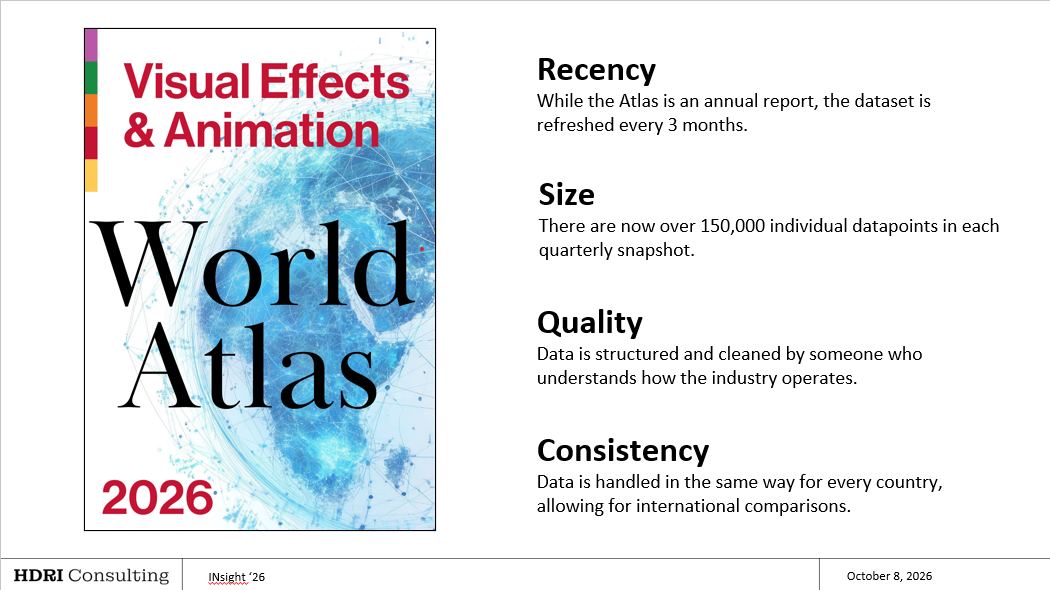
Bell explained that the VFX Atlas was created to fill a gap: individual countries and regions such as the UK, France and Quebec gather excellent data for their own purposes, but there was no consistent view of the size and shape of the global industry, or of movement between regions. The Atlas takes a different approach to a survey. Every three months, it collects publicly available professional profiles of people who say they work at one of around 2,900 VFX and animation studios, producing a data set of roughly 150,000 people. A small team led by Bell, who has worked in the industry for over 20 years, categorises roles by how work is actually done in studios, and the same method is applied in every country. The data includes people working on animated features at VFX studios such as DNEG, Cinesite and ILM, but not studios such as Disney Animation that do not offer VFX.
The key findings were:
- Global headcount is broadly stable: VFX employment changed by about 1.5% over the past 12 months, so the industry has not “cratered” because of AI, though there is considerable movement between companies, cities and countries beneath that figure.
- Movement follows incentives: Bell pointed to the Canary Islands, where the Spanish national incentive is stacked with a special economic zone incentive to create one of the highest offers in the world, and where DNEG recently bought an animation studio.
- Animation changes the picture: UK VFX headcount was down 1.7%, but combining VFX and animation studios it was up 1.4%. Ireland’s VFX headcount fell by close to 25% but rose by 31.5% once animation was included, while smaller markets such as Ireland and New Zealand can swing sharply when a single large studio starts or finishes a project.
Ireland: opportunity and limits
Ireland’s new VFX uplift prompted discussion. Miller, who recently visited Belfast and Dublin, reported strong optimism: Studio Ulster and several Dublin studios have busy order books, further Amazon projects are expected, and the main constraint is a shortage of talent. Bell noted that Ireland’s industry is small compared to the UK’s and can only grow so fast. Incentives are fickle, but the UK’s uncapped, long-term offer gives major clients the confidence to plan years ahead. Parker added that he did not expect other territories to match the UK’s combination of investment, stability and production heritage, although the industry still needs to adapt.
Why has work contracted?
Asked about studios closing despite stable production spend, the panel attributed the downturn mainly to the retrenchment that followed the 2022 streaming peak, when platforms competing for subscribers spent heavily on content, before shifting focus to profitability. Bell noted that a small number of Hollywood companies account for most global VFX spend, so a decision to spend less sends shockwaves around the world, and expected spending to swing back as more platforms become profitable. Parker pointed out that total content investment is now close to 2022 levels, but that profitability has come from advertising and that sports rights are absorbing a growing share, so the question is whether that investment reaches VFX and post-production businesses.
Miller, who speaks regularly to small and mid-sized studios, said sentiment was markedly more positive than a year ago. Difficult conditions have spurred an entrepreneurial streak, with more studios exploring original IP, co-productions and festival-bound short films.
Blind spots and risks
Responding to an audience question on where the UK might fall short, panellists highlighted:
- Fragmented representation: Miller argued that the industry lacks a global association to share knowledge, which currently sits in regional silos.
- Global visibility: Bell stressed the value of tracking what other countries are doing, since it is usually clear why work moves, and more a question of seeing when those factors take effect.
- Narrow definitions of the industry: Parker warned against dismissing the creator economy, advertising and AI-generated video as sources of competition.
A further audience question raised the UK’s regulatory environment, business rates and limited access to capital. Bell noted that Australia’s strong incentives have not translated into growth because of the difficulty of bringing in talent from overseas. Parker acknowledged there is no easy answer for how a post-production facility survives in a high-cost region as remote workflows reduce facility utilisation. He urged the industry to engage directly with the studios and streamers making spending decisions, rather than only talking amongst itself.
AI: gradual integration, not replacement
Bell reported that only around one in 1,000 of the 150,000 job titles in the Atlas explicitly references AI. If AI had transformed the industry overnight, studios would have swapped their compositors for generative AI artists, whereas in practice compositors are using AI selectively to work more efficiently. He argued that clients still demand pixel-perfect control, which established pipelines and experienced artists are built to deliver, and that machine learning has been used in VFX for years. An audience member suggested companies may be cautious about publicising dedicated AI roles, given the reaction to past job adverts, a point Bell accepted, while adding that even AI-first work needs a final human pass.