
A panel of industry experts look beyond the demos to how AI is actually being used in VFX pipelines, and what it means for governance, costs and the next generation of talent
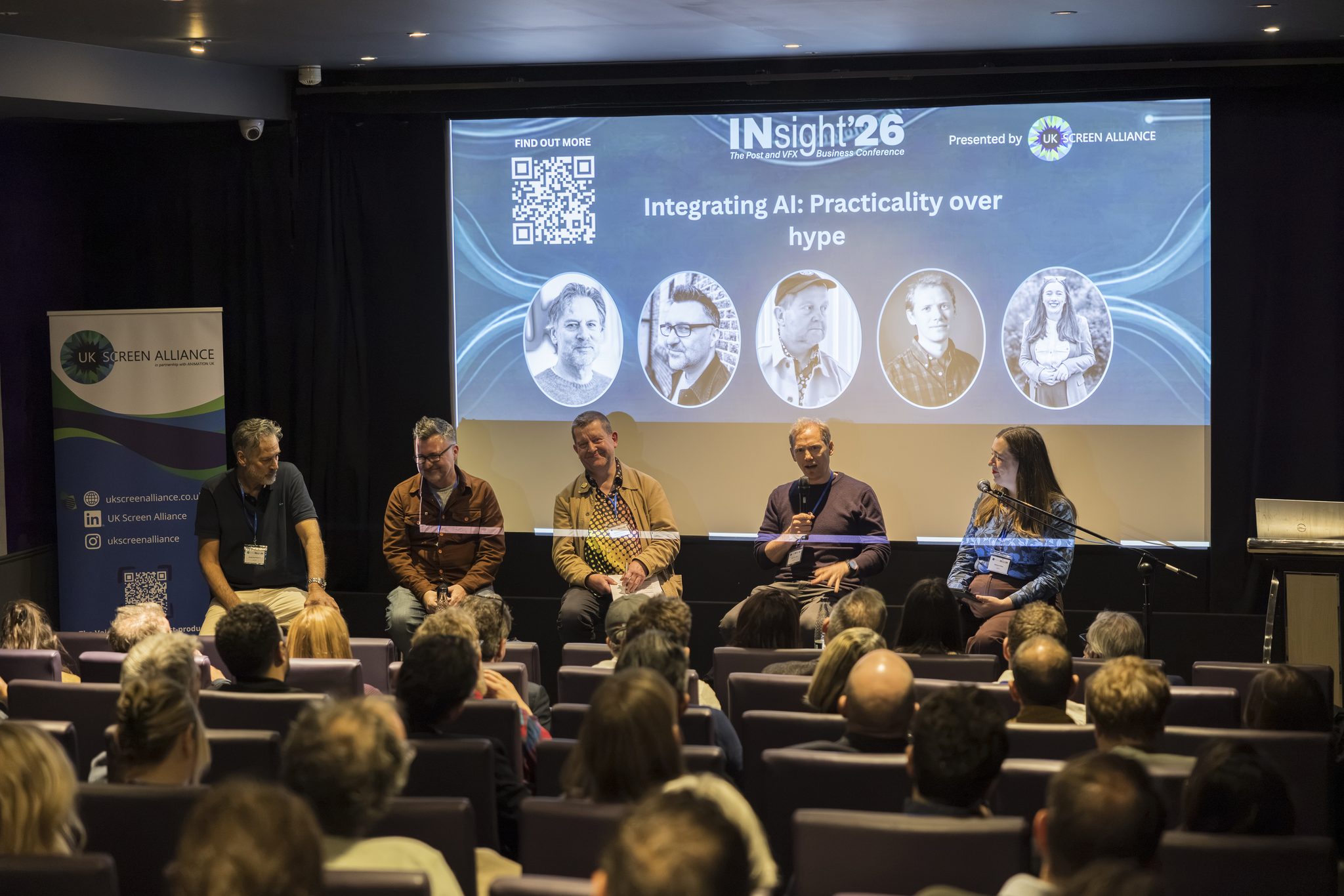
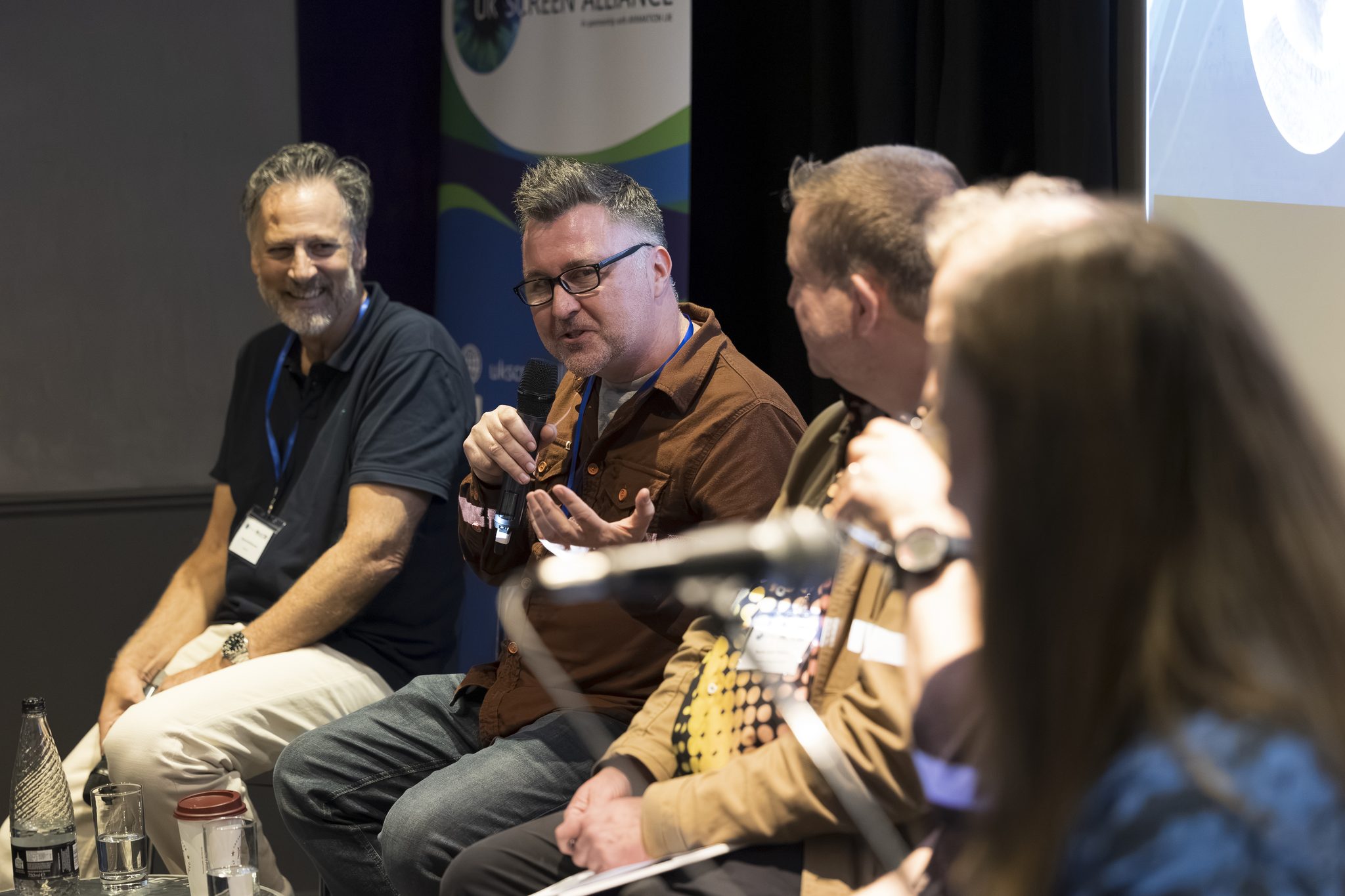
The second panel of INsight’26 set out to move the conversation about AI on from shiny demos to day-to-day practice. Moderated by Kathryn Webb, Managing Director of AIMICI, it brought together Steve MacPherson, Chief Technology Officer at Milk VFX; Andy McNamara, Director of Creative Innovation at Outpost VFX; Saint John Walker, Programme Leader in postgraduate media at the University of Hertfordshire; and William Bartlett, Executive Creative Director at Framestore.
Where AI is showing up
The panellists agreed that the technology is powerful but that hype has set expectations too high. MacPherson described a pattern of impressive early results, particularly in pitch visualisation, that are hard to carry through to finished work. Artists can move from a sketch to a rigged, animated creature in hours, but finishing the work still means returning to the pipeline. His interest is in tuning tools so that AI becomes an unremarkable part of the artist’s toolkit.
McNamara noted that studios are emerging from a discovery phase and looking for tangible outcomes, adopting cautiously and with client permission. Much of what is labelled AI is an incremental extension of machine learning VFX has long used, such as denoising, upscaling and retiming, alongside newer one-shot roto, object removal and wire removal. Fully generative shots remain out of reach, not least because of the volume of client notes that production involves.
Bartlett noted that Framestore’s wide client base means AI is used very differently across the business:
- Feature films: copyright and IP security are paramount, so Framestore develops tightly controlled tools, trained on known data and hosted on its own systems, to speed up existing tasks such as roto and tracking.
- Advertising: clients are less protective of IP and more ambitious relative to budget, so AI is already producing final pixels in some projects.
He expects advertising to flip from slotting AI into existing processes to building the workflow around it, using traditional skills such as proxy CG models and animation to guide and curate generative output, because text prompts alone give too little control. That would bring tighter iteration with clients and a different mix of skills.
Clients, costs and control
Clients now routinely ask what a studio’s “AI option” is. McNamara urged that studios must be honest brokers about where the benefits are real, and noted that large streamers are far more willing to engage than a year ago. MacPherson added that VFX is a margins business, so hidden pipeline improvements that are invisible to clients can make the difference between profit and loss. His concern is that easy access to AI has led clients to undervalue craft, and that expectations and budgets are shrinking faster than tooling can compensate. He also described a texture lead who “vibe coded” an extension to an in-house tool over a weekend. A senior developer reviewed it, and it was checked into version control, so that it could be treated as a prototype and made production-ready.
On what makes a tool fit for live work, McNamara responded that VFX depends on predictable, iterative refinement, and general-purpose models cannot yet be controlled down to pixel level without repeated re-rolling. Bartlett offered a counterpoint from his years as a director: filmmakers never control every pixel and instead curate versions and give broad notes. In his view, directing AI is not so different, and human creative input remains essential for anything longer than a short clip.
Governance and transparency
For MacPherson, governance is principally about cost. Frontier models are heavily subsidised by investors and future pricing is unpredictable, so he is looking at smaller domain-specific models run locally for tasks like roto and dust-busting. These also reduce security and IP risk. McNamara added that owned models can be retrained over time, which closed models do not allow.
Bartlett explained the first rule is total transparency with clients, and described a three-tier framework used as a starting point for conversation:
- Tools hosted on Framestore’s own servers, with fully traceable data sets, for lower-risk tasks.
- Tools from trusted external providers, with agreements that work is not viewed by staff or used for training and data centre locations are known.
- Everything else, which clients must explicitly approve, sometimes through third-party platforms that provide indemnity against copyright claims.
Skills, education and entry-level routes
Walker highlighted a concern in education with “never-skilling”, where students opt out of learning because machines will supposedly do the work, and “cognitive offloading”, which is acceptable if enough skill is retained to orchestrate the tools. He encourages students to see that humans are the loop, rather than simply in it. Because a three-year degree spans as long as the period since ChatGPT launched, Hertfordshire teaches workflow and node-based orchestration through ComfyUI rather than any one product, and he said black-box tools are unsuitable for teaching.
Walker saw responsibility for training as shared, with universities able to offer closer industry partnerships, live briefs, short courses and micro-credentials. He reported that recruiters are now asking for AI work, credited, on showreels, with one multinational moving from awareness of AI to “light operational usage”. McNamara called for AI literacy from secondary school upwards, comparing it to the IT literacy of previous decades, and argued that creativity, shot judgement and generalist skills will matter more than button-pressing in specific software. MacPherson added that learning how to learn is a superpower, and that AI is useful for challenging assumptions.
Audience questions
Responding to questions, the panel covered:
- Admin: AI is already being used for dailies note-taking, script breakdowns, bidding support and scheduling complex dependencies.
- Pipelines and team shape: MacPherson and Bartlett expected smaller, senior, co-located teams to benefit most, reversing years of increasing specialisation. Bartlett expects advertising to lead and film and TV to follow once the approaches are proven.
- Bidding: McNamara said it is difficult to bid for AI as a line item with so little data, while Bartlett said tokens are now sometimes estimated as a line item. MacPherson likened token pricing to a volatile stock market, and said on-premises models are an increasingly attractive way to regain financial control. Bartlett stressed that the greater concern is the loss of entry-level technical roles, which have traditionally been where juniors prove their creativity.