
“The decisions we make now will shape the industry for years to come”: Neil Hatton’s call to action for employer engagement in Film, TV, and VFX further education
Capital City College (CCC) has launched a Creative and Digital Specialist Hub and Skills Advisory Board at its Mosaic@Soho campus, bringing together employers, educators and students to shape the future of digital and creative skills across London. This board launch is especially timely, following from the recent UK Government announcement this week of five new Technical Excellence Colleges (TEC)s, including CCC as a TEC for digital and technology.
At a busy launch event held this week, this new advisory board saw strong engagement from industry partners, including employers from global organisations, innovative start-ups and SMEs.
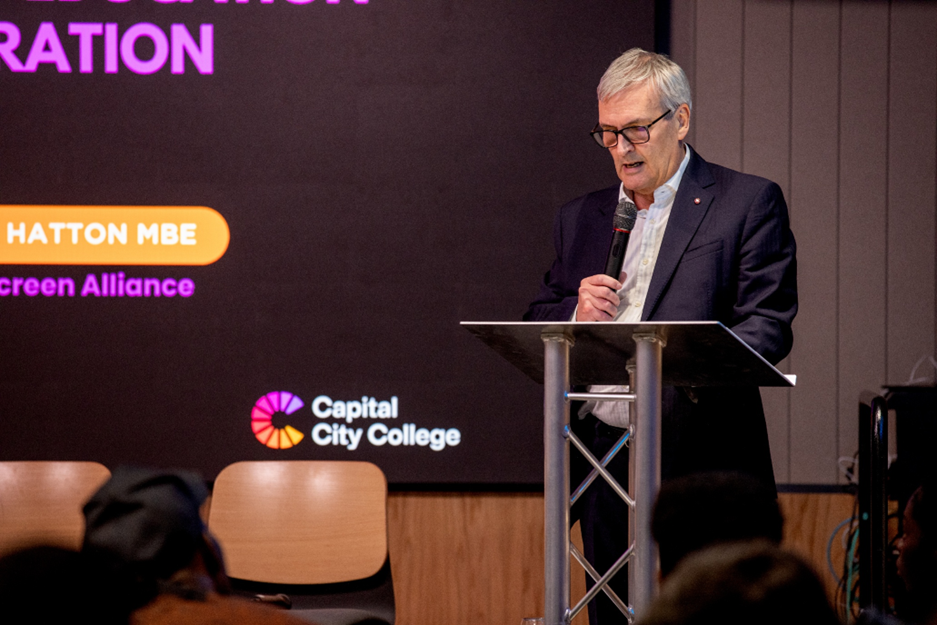
The event opened with a keynote from UK Screen Alliance CEO, Neil Hatton MBE, making the case for stronger engagement from employers in the film, TV, and VFX industry with the further education sector. With industry-aligned qualifications under threat from government reform and a generation of new talent at risk of being lost, he warned that inaction now could mean critical skills shortages when the sector’s recovery gathers pace.
Read Neil’s speech below:
Strengthening Employer Engagement in Further Education for Film, TV and VFX
Good afternoon everyone,
It’s a pleasure to be here with you today—educators, employers, and learners—people who collectively shape the future skills base of the UK’s film, television, animation, and VFX sectors.
Today, I want to focus on employer engagement with education—not as a “nice to have,” but as a strategic necessity.
Our creative industries are one of the UK’s great success stories: contributing an estimated £145.8 billion to the economy. That’s 5.5% of the UK’s GVA. They are a global export powerhouse, a magnet for inward investment, and a defining cultural asset. They are rightly recognised as a priority sector within the government’s Industrial Strategy.
And yet, this is also an ecosystem under extreme pressure, particularly in film and television, with rapidly evolving business models, adjusting to new geopolitical and investment realities, and disruptive technological change.
But just as TV and Film has its challenges, so too does education. Further Education has long operated under financial constraints, now compounded by a constantly shifting policy environment such as T Levels, V Levels, and the transition to a Growth and Skills Levy.
We may not agree with all these reforms. The creative industries—with their project-based nature—don’t always fit neatly into standardised systems. In some cases, government proposals risk undoing progress already made.
But this is precisely why employer engagement matters more, not less. As change accelerates, we must be actively involved—pragmatic, collaborative, and focused on shaping workable solutions. Its what we do day-to day-anyway!
Let’s look at the industry context and while recent history seems bleak, there is some sunlight.
Film and television have had a difficult three years. Since the pandemic, we’ve gone from the boom of peak TV and Covid catch-up, to the disruption of the writers’ and actors’ strikes. Beneath those strikes was a deeper recalibration: a shift from subscriber growth to profitability in streaming services, leading to reduced commissioning of original content. The anticipated post-strike recovery didn’t fully materialise.
Domestically, the BBC’s budget has fallen 30% in real terms, while for commercial broadcasters the cost-of-living crisis has weakened advertising revenues. The result has been less investment in content.
The film and TV world as we knew it before the pandemic, is not the reality now and we are still adjusting to a new normal.
Across the supply chain, we’ve seen redundancies, hiring freezes, and fewer entry-level roles. For many trying to enter the industry, opportunities simply haven’t been there.
And yet, this is not a story of decline across the board.
There are clear signs of renewal in some parts.
In VFX, recent tax credit uplifts are reinforcing the UK’s position as a global destination for inward investment. Data from the World VFX Atlas shows the London VFX and animation workforce grew by 10% over the past year. That is significant. 1000 people in new jobs.
Yes—budgets are down. Contracts are shorter and harder won. But the direction of travel for VFX is positive. There are tantalising signs of at least another 5% growth over the next 12 months. The global pie for VFX may have become smaller—but as a result of the tax credit changes that we campaigned for and won last year. the UK is poised to take a larger slice.
However, we must be realistic. The first phase of recovery focuses on experienced professionals—bringing back those who were laid off. Entry-level hiring may take little longer to return.
This creates a dilemma.
Because education does not operate on a one-year cycle. You can’t just turn it on or off based on current demand. It operates on a pipeline of three, five, even ten years.
If we allow that pipeline to weaken now, we may face labour shortages just as the industry hits its next growth phase.
Let’s zoom out further and consider the full talent lifecycle.
The digital VFX industry is still relatively young. It really began to take shape in the late 1980s and early 1990s. From 2001 to 2011, it gained significant momentum in the UK, mostly thanks to a young wizard called Potter.
Many of its early pioneers—those with 30-plus years of experience—will begin to step back in the coming years. This is not an immediate retirement crisis, but it raises important questions: will we have the right mix of skills and experience at the right time?
That depends on a functioning talent development pipeline—where mid-level professionals are supported to progress, and new entrants are ready to step in behind them.
It will just mention AI. It will have an impact, but not as existential as the doom-mongers have been predicting. It’s another useful tool in the box and creates opportunity if embraced thoughtfully. The jobs are still there but with upgraded skills.
I will just mention AI. It will have an impact, but not as existential as the doom-mongers have been predicting. It’s another useful tool in the box and creates opportunity if embraced thoughtfully. The jobs are still there but with upgraded skills.
At the same time, film and TV are no longer the only destinations for students who study it.
3D and real-time technologies are expanding from gaming and virtual production, into architecture, product design, immersive experiences, and beyond. 3D visualisation is increasingly embedded in sectors like automotive, healthcare, criminology, and life sciences.
We are also seeing the growth of the creator economy, where people are ignoring conventional career pathways. They are getting on with just doing their own thing, choosing to build their own opportunities rather than following traditional career pathways.
Now let’s turn to the education landscape itself, and to set the scene, I want to rewind fifteen years to 2011.
This report called Next Gen was published by NESTA. It was written by Ian Livingstone, founder of Eidos, and Alex Hope, founder of DNEG. Its subtitle was “Transforming the UK into the world’s leading talent hub for the video games and visual effects industries.”
In 2011, VFX and Games were enjoying a period of growth but they were already suffering skills shortages that were only alleviated by sourcing excellent skilled talent from overseas, an avenue that just a few years later would be choked off by Brexit.
The report was critical of the subjects then available in the curriculum, and advocated for the blend of skills required by these frontier sectors to thrive, namely STEM coupled with Art and strong emphasis on coding.
The report inspired a group of forward thinking games and VFX employers to collaborate with AIM Awards to create a Level 3 extended diploma in Games, Animation and Visual Effects Skills, as still taught with great success here today at Mosaic.
Additionally these employers developed a strong and innovative package of industry engagement for the colleges teaching the qualification, and formed the NextGen Skills Academy network of affiliated colleges.
Mosaic is one of 13 colleges teaching the Next Gen qualification. Across the UK there’s around 600 students currently enrolled. And the outcomes are good with 78% of alumni passing into higher education on relevant degree courses, 12% starting work directly and 8% getting apprenticeship placements.
So far so good, but here’s the rub.
Government policy is moving towards a simplified Level 3 landscape centred on T Levels, V Levels, and A Levels. Specialist qualifications like NextGen—and others such as UAL diplomas—are at risk of defunding.
These qualifications underpin the teaching in specialist institutions like Mosaic, but also at London Screen Academy, ELAM and The Brit School and provide flexible, industry-aligned pathways. To lose these qualifications would significantly impact how we prepare students for careers in the creative industries.
It looks as if the UAL qual will be defunded by the academic year 27-28.
The Aim/NextGen qual could survive until 2029-30, but it’s living on borrowed time.
We are expecting DfE and Skills England to issue an implementation plan that confirms these timelines in June or July this year.
This is understandably frustrating. Industry has already invested heavily in building effective pathways. What exists is not broken—and does not need fixing in this way.
But we are rapidly approaching the end of the runway and may soon need to consider alternatives. Doing nothing is not an option. Nor is accepting new qualifications designed without meaningful industry input.
Employer engagement, therefore, becomes essential.
If industry does not actively shape these new pathways, we risk ending up with systems that fail to meet real-world needs.
So what are the options?
T Levels offer depth and include a mandatory work placement—but raise challenges around scalability, geographical access, and employer capacity.
V Levels provide broader reach without mandatory placements—but with significantly reduced teaching time.
We may need to support both, depending on context and future announcements on placement flexibility.
So how do we move forward?
First; stronger collaboration.
Advisory boards are important to create deeper partnerships—co-designing courses, sharing insight, and creating fast, effective feedback loops.
Curricula must reflect real industry needs. That doesn’t mean chasing every new tool, but it does mean focusing on core, transferable skills: problem-solving, storytelling, shot composition, communication, collaboration, and adaptability. The Core Skills of VFX Handbook that we co-funded last year is example of effective collaboration between academia and industry.
Second; placements and apprenticeships.
There is no substitute for real-world experience. But we need more flexible models—shorter placements, project-based work, virtual opportunities.
We need to bring employers to students as well as students to employers.
Apprenticeships remain valuable, but must work for employers—supported by appropriate incentives and flexible delivery models.
I will continue to press government to build these necessary flexibilities into T Levels and apprenticeships. But we will need employers of all sizes to open their doors to more students.
Third; tutor development.
Educators need access to industry to teach effectively. If we invest in teachers, we invest in every student they go on to teach.
We should expand opportunities for industry exchange—teachers gaining industry experience, and professionals contributing directly to education.
I’m proposing a pilot scheme with the GLA to encourage bidirectional industry exchange initiatives—where tutors go on placements in studios—and industry professionals spend time teaching in colleges.
There’s real progress on the horizon here.
And finally; inclusion.
We must widen access—not only because it is right, but because diversity goes hand-in-hand with creativity and innovation.
This means reaching new communities, creating alternative entry points, and ensuring pathways are visible, accessible, and viable.
So, to conclude:
The industry is beginning to recover. Growth is on the horizon. But the talent pipeline that underpins that growth needs attention now.
My call to action is simple.
To employers: see education as part of your workforce strategy. Offer placements, contribute to curriculum development, and invest time in shaping the future talent pool.
To educators: continue to adapt and innovate. Build partnerships, focus on core skills, and prepare students for long-term careers, not just first jobs.
And to all of us: work together.
If we act in isolation, we create fragmentation and inefficiency. In a time of constrained resources, collaboration is essential.
None of this is easy. But difficulty is not an excuse for inaction. The decisions we make now—about engagement, collaboration, and investment—will shape the industry for years to come.
The Next Gen report remains as relevant today as it was 15 years ago. I’m going to borrow Alex Hope’s final words in his conclusion to the report, as they seem to perfectly sum up this call to action. He said then, “We cannot sit back and allow others to do it for us. We must step up and contribute.”
I echo his words and sentiment. I’m up for it. Are you?
Thank you for listening.